Dashboards
Early Warnings
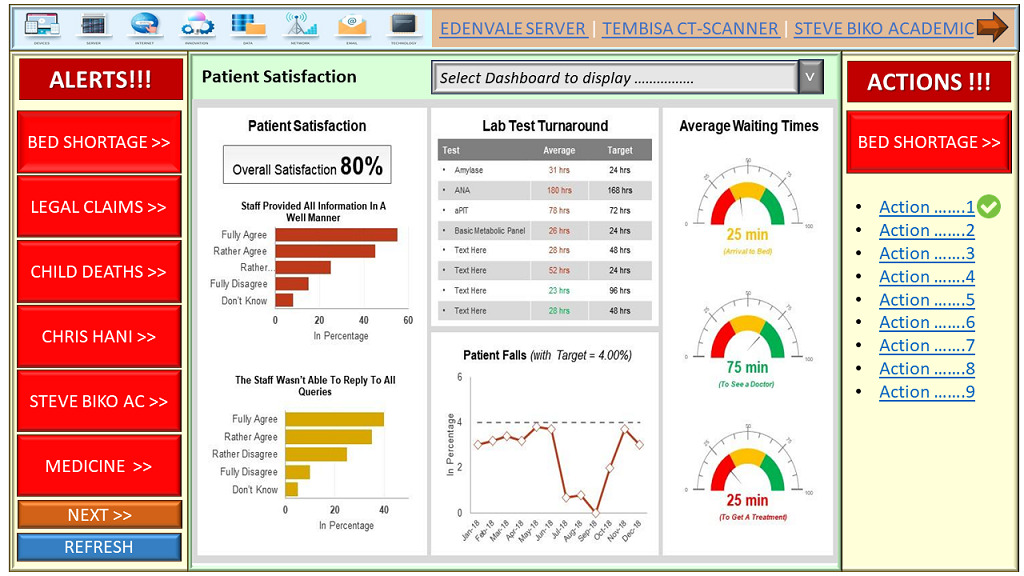
A dashboard is a visual tool for measuring performance over time. The dashboard compare achievements to set milestones and goals and represent progress and status visually through the use of graphs and charts.
A dashboard provides also a framework to monitor performance progress and track daily, monthly, or annual variances. Doing so can help you pinpoint particular areas of performance that need improvement.
By having an effective tool to standardize performance tracking, project sponsors, project managers, stakeholders, team members, and others can rest assured that performance will improve over time.
A dashboard connect to various identified sources of operational data to analyse data based on pre-configured parameters to provide a progress / alert response.
Systems in Health Care...
An early warning dashboard system for monitoring healthcare services provided by various hospitals and clinics can connect to a wide range of systems and data sources to gather relevant information. Some of the key systems it can connect to include:
- Hospital Information Systems
- Electronic Health Records Systems
- Laboratory Information Systems
- Radiology Information Systems
- Patient Monitoring Systems
- Pharmacy Management Systems
- Supply Chain Management Systems
- Tele-health Platforms
- Public Health Data Sources
- Quality Improvement Systems
- Billing and Claims Systems
- Emergency Medical Services Systems
- Health Information Exchanges
- Disease Surveillance Systems
- National and International Health Organizations
Benefits in Health Care...
An early warning dashboard for healthcare offers a range of benefits that contribute to more effective patient care, improved clinical outcomes, and better overall healthcare management. Some of these benefits include:
- Timely Intervention
- Improved Patient Outcomes
- Reduced Mortality and Morbidity
- Resource Optimization
- Enhanced Patient Safety
- Data-Driven Decision Making
- Streamlined Workflow
- Patient-Centered Care
- Chronic Disease Management
- Research and Quality Improvement
- Emergency Preparedness
- Remote Patient Monitoring